


Don’t Panic: Facing Volatile Markets During Coronavirus

Offshore Investing: What is the optimal timing and percentage to invest offshore?
February 12, 2020
As markets swing with the outbreak of Coronavirus, a plunge in the price of oil, and the U.S election race, investors need to buckle down and understand the price of the risks they are taking with their financial portfolios.
As we head into the third month of Coronavirus panic, and now the first confirmed case in South Africa, most people are stocking up on anti-bacterial wipes, face masks and hand-washing tips. But there is also another area of concern sparked by the disease: a volatile stock market.
Coronavirus has weakened most Emerging market (EM) currencies, particularly those with high current account deficits that rely on commodity exports, down c. 10%–20% this year.
It sent U.S bond yields to record lows (both 10 year and 30 year bond yields are below 1%), rallied gold by over 10%, and pulled back global equity markets by between 10% and 20%. Brent Crude Oil had its largest daily fall of 21% and is down 50% year to date. Newspaper headlines continue to spread tales of impending market doom (“Markets are swinging wildly” – CNN; “ Coronavirus Fears Drive Stocks Down for 6th Day…” – The New York Times). Recently, we were sitting on -12% drawdown year to date for the S&P500; the average drawdown over the last 90 years is -13%. The companies most affected by the outbreak are those in the travel and luxury goods industries.
It’s no wonder equity investors are worried. But, as a long-term investor, this likely isn’t the first – and certainly won’t be the last – time you face this potential for loss.
After all, as Charlie Bilello, the founder and CEO of Compound Capital Advisors, explains: “We observe this each and every year in the equity market, to varying degrees. In the median year since 1928, an investor in the S&P 500 has experienced a 13% drawdown at some point during the year.” Have a look at this chart:
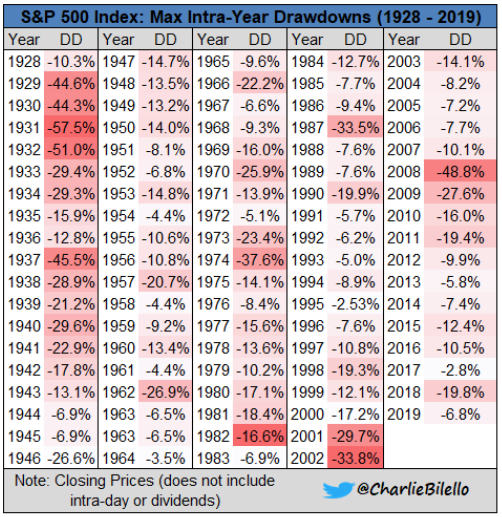
To put it simply: long-term equity investing is uncertain, but it is still one of the best-performing asset classes over the long term. Volatility in uncertain markets is the price you pay for the potential high returns over the longer term.
Nobody knows what the short term holds and it’s impossible to make predictions, but the following facts hold true:
- Markets will always go up and down, market declines feel uncomfortable for investors. It is in these uncomfortable moments that opportunities arise and fund managers can buy shares at a discount.
- Equities have historically been the best performing asset class. “The premium you earn from owning equities over bonds/cash is primarily due to the higher volatility and drawdowns you must stomach over time,” says Bilello.
- There is a price of admission for being in the market and that is what we are experiencing right now.
- This could be considered normal price action. The decline may simply feel worse than normal, since the market has been on a flawless run for the past 5 months.
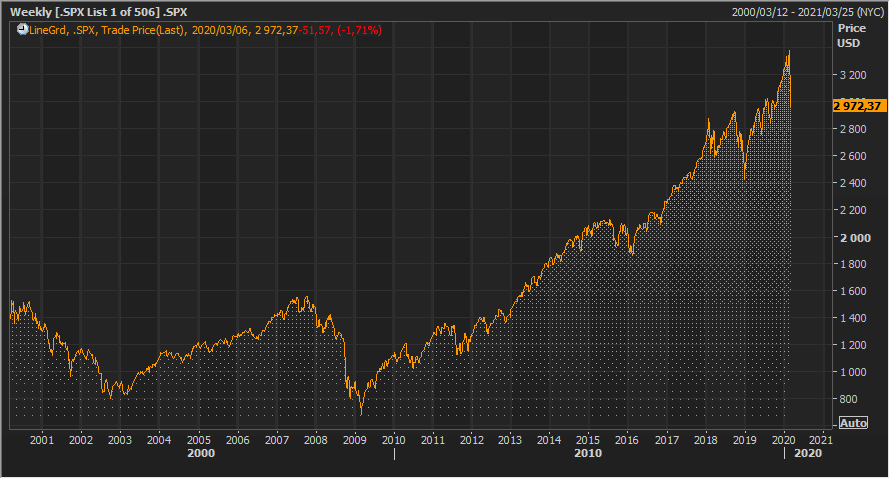
Looking at the graph below, the declines of 2008/9 are substantial, and at the time it seemed as though the world was ending, but for a long term equity investor who held on through the declines the benefits of being a patient investor with eyes on the horizon paid off.
Limit the risk
Timing the market is impossible, so don’t panic and sell out of the markets unless your risk capacity/risk tolerance levels have dropped. Risk appetite is different from risk capacity, an investor with a high degree of risk appetite might want to invest in a risky portfolio but their risk capacity might constrain them.
Risk capacity is a dynamic concept, so let’s discuss what affects levels of risk capacity:
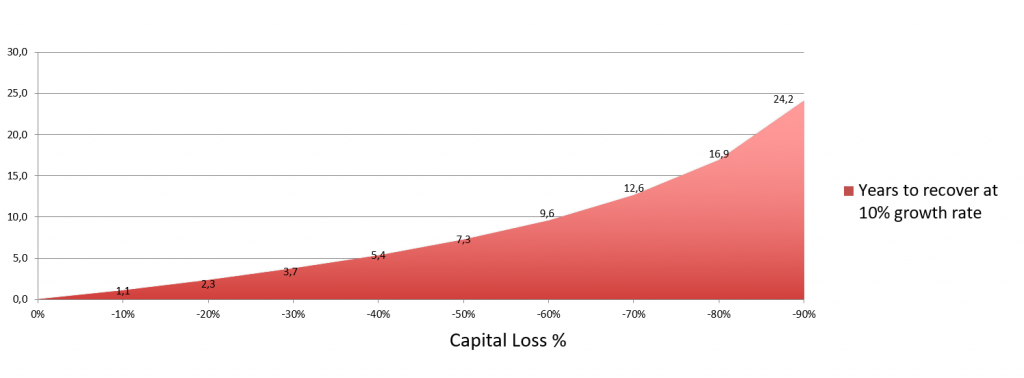
- Age – The closer we get to retirement, the less risk we can take because we may not have the time to make back the losses – for example, it will take 7.3 years of 10% growth to recover a 50% drop in the value of your investment. See graph below.
- Term to retirement – people retiring should naturally take less risks than those with their whole working lives ahead of them.
- Loss of a breadwinner.
- Personal business or employment outlook.
- Change in health.
- Presence of other assets within a portfolio such as pension, property or inheritance.
- Requirement for income drawn from your investments.
- Changes in inflation.
Investors should never let one event or one day’s market activity change their bigger financial, investing and retirement plans. Remember the Great Financial Crisis of 2008/9: many people panic-sold their stocks at all-time lows when on March 9 2009 the Wall Street Journal’s headline was “How low can stocks go”. This was the day the markets bottomed out. You may end up selling low and buying high. It’s best to remember your long-term plans, and stick this out.
If you are looking to mitigate your risks going forward, develop a diversified portfolio that is made up of different asset classes, and most importantly make sure that the risk within your portfolio matches your risk capacity, not your risk appetite.
If you’d like to review and update your portfolio, contact us.
